Sip Tea with Saba: Chaparral Bush
- Saba Tesfay

- Aug 3, 2025
- 6 min read
The statements in this editorial are simply for informational purposes, entertainment, and objective research and do not represent the views or policies of the publication, or any other organization with which the author may be affiliated. They are also not to be viewed as personal medical care, but rather for the purpose of general knowledge. The author is not a medical professional. The reader is strongly encouraged to speak to his/her own physician for medical advice.
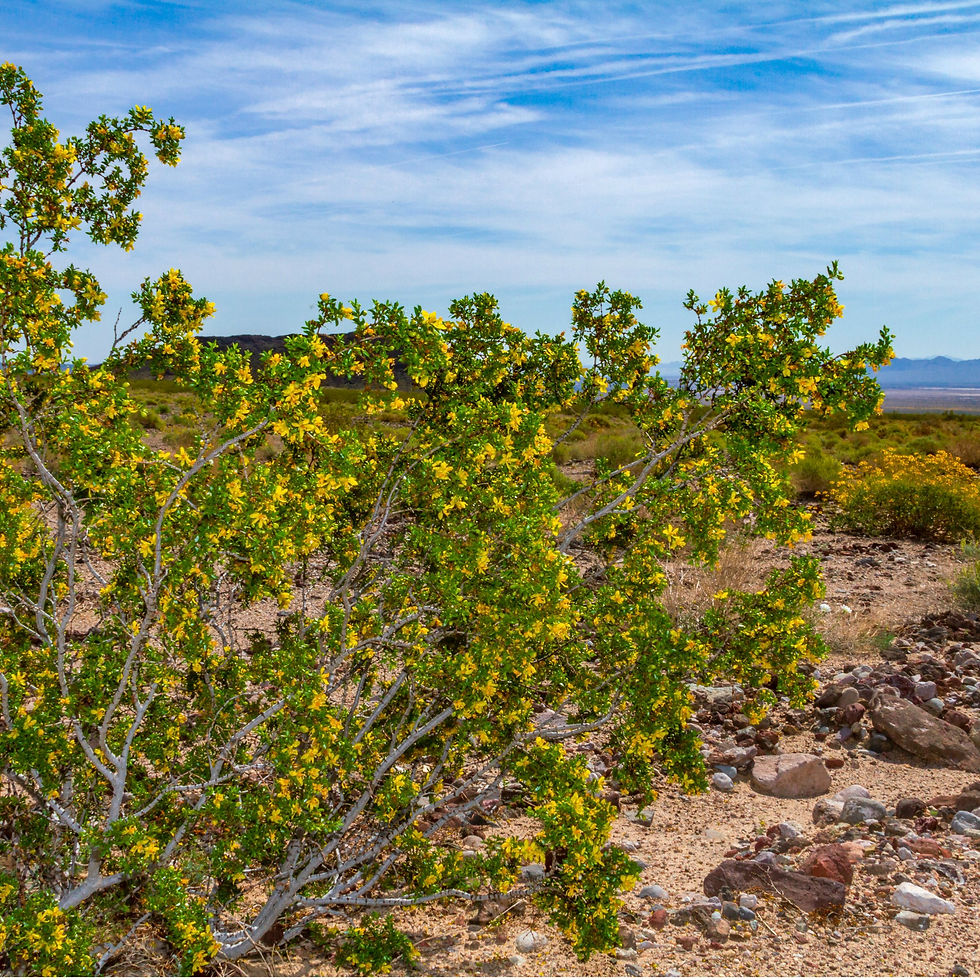
Chaparral Bush
We got through a large chunk of summer, and while it wasn’t 120 degrees like last year, it was still extremely hot! Being born and raised here in Las Vegas (thankfully with lots of travel and escape), I can assure you that one of the sweetest smells for locals after a streak of blazing heat is the distinctive scent of “the smell of rain.” Here in the Mojave desert that specific smell is actually the oils emitted from a hearty bush as moisture begins to cultivate in the atmosphere, and we all get the signal that rain has the potential of falling, and a glimmer of ‘Inner Peace’ permeates through our dried out bodies (and I’m not talking about the Inner Peace High Tech Healing sleepy time tea…)
Full disclaimer- whenever reading my ‘What’s the Tea articles’, please read to completion to ensure you understand any cautions to use with herbs or potential health hazards. All herbs live on a scale from tonic to toxic depending on your health condition and usage, so it’s always important to speak with a health care practitioner to ensure you utilize them safely!
What’s the Tea on Chaparral Bush?
In the vast, sun-drenched landscapes of the American Southwest and parts of Mexico, a resilient shrub stands as a testament to adaptation and survival: the chaparral bush, also known as creosote bush (Larrea Tridentata). It blooms yellow flowers, has small yet thick leaves, and produces small adorable puff balls. Its distinctive scent, often described as the “smell of rain” when the desert is wet, evokes a primal connection to this arid world. And this connection is more than just of plant and human, it also holds profound cultural significance and a complex relationship with human health, both ancient and modern.
The history of the chaparral bush stretches back millions of years, with fossil records suggesting its presence in the early Miocene (this is about 23 - 2.6 million years ago)! The chaparral’s ability to thrive in harsh, low-nutrient, and often rocky soils, coupled with its remarkable drought resistance (reminds us of home right?), has allowed it to become a dominant species across the Mojave, Sonoran, and Chihuahuan Deserts. One of the most astonishing examples of its longevity is “King Clone”, a single clonal colony of Larrea Tridentata in the central Mojave Desert, estimated to be an astounding 11,700 years old- making it one of the oldest living organisms on Earth. This ancient lineage speaks to its incredible evolutionary success and resilience.
Tribal Land Acknowledgment
However, we wouldn’t have these historical records and herbalist wisdom, if it wasn’t for the indigenous people of every land. Here in Las Vegas, the region’s vibrant Native American history began with the Desert Archaic people (Pinto-Gypsum Archaic), who hunted and gathered from roughly 3,500 BC to 1 AD. They were followed by the Ancestral Puebloans (formerly Anasazi) who, between 200 and 1150 AD became adept farmers, leaving behind fascinating archeological clues like ancient settlements and irrigation systems. Since approximately 900 AD and continuing to thrive today, the Southern Paiute people have been the primary indigenous inhabitants. Nevada is home to 21 federally recognized tribes, encompassing 28 reservations, bands, colonies, and community councils, and what’s left of these tribal lands collectively cover 1.6 million acres across the state. The BLM Bureau of Land Management owns about 48 million acres of public land (which is about 60%+ of the state).
We have herbal wisdom BECAUSE of indigenous knowledge
Native Americans meticulously observed the natural world, passing down vast knowledge and wisdom about the medicinal properties of herbs and plants through generations, often orally, integrating their use into holistic healing practices that we still observe today.
The cultural significance of chaparral for Native American tribes across the Southwest cannot be overstated. This plant was seen and used as a “cure-all” and a vital resource. Its branches were used to construct summer shelters, providing much-needed shade against the relentless desert sun while the resinous lac, an fluid produced by insects on the plant, served as an invaluable adhesive for mending pottery, waterproofing baskets, and attaching stone tools to shafts.
Medicinally, chaparral was, and in many communities still is, deeply revered. Decoctions and teas made from its leaves were traditionally used for a vast array of ailments. The Coachuilla used it for intestinal complaints and tuberculosis, while the Pima drank a leaf devotion as an emetic (something to induce vomiting) and applied boiled leaves as poultices to wounds and sores. The Tohono O’odham prepared it for stiff limbs, snake bites, and menstrual cramps.
When I went on some traditionally wildcrafting tours to learn about the various plants in nature, I learned that so many of the plants were used for venereal diseases. Its perceived ability to treat sexually transmitted diseases, chickenpox, rheumatism, and even fevers underscores its widespread application in traditional healing systems. Beyond its practical uses, chaparral leaves were sometimes burned during ceremonies, further cementing its sacred status.
The Science Within
Modern scientific inquiry has begun to unravel the complex chemical profile of chaparral, identifying several bioactive compounds that likely contribute to its traditional uses. The most well-studied is nordihydroguaiaretic acid (NDGA), a potent antioxidant. Chaparral is also rich in other lignans, flavonoids, and essential oils.
Laboratory and animal studies have explored various potential pharmacological activities of chaparral and its constituents. NDGA, for instance, has demonstrated antioxidant, anti-inflammatory, and anti-viral properties in test-tube settings. Some research has hinted at its potential to inhibit cancer cell proliferation and replicate certain viruses, including HPV, HIV, and HSV, though these findings are primarily from in vitro or animal models and require much more rigorous human studies. Its antimicrobial effects have also been noted, aligning with its traditional use for skin infections and wounds.
Crucial Note of Caution
As mentioned from above, depending on your current health (liver health to be specific) certain herbs should be used with caution as they can cause toxicity due to the potency.
A crucial note of caution must be sounded here: despite promising in vitro findings, the internal use of chaparral, particularly in concentrated forms like capsules or tablets have been linked to serious liver and kidney damage, including cases of acute hepatitis and organ failure. The FDA has issued warnings against its internal consumption, and it is banned in some countries. This toxicity is a significant concern that limits its modern clinical application.
Testimonials of Topical Use
With the scientific warning in mind, some users report positive experiences, particularly with topical applications for skin conditions. For instance, individuals claim remarkable results in treating fungal rashes, insect bites, and eczema, describing a soothing and healing effect. Some have shared stories of using chaparral externally for chronic skin disorders or as a poultice for minor wounds, believing it aids in recovery.
A few testimonials also describe conditions like a persistent scalp itch, where individuals use a chaparral rinse to dramatically reduce symptoms. Similar to what we learned from the Natives as they used it for snake bites or external issues. Others speak of using it for general wellness or to ward off colds, citing personal success despite the known risks. However these personal accounts are often balanced by stark warnings from medical professionals and regulatory bodies.
Our Desert Legacy
The chaparral bush, with its ancient roots and enduring presence in the arid lands, is a powerful symbol of desert resilience. Its deep cultural significance to Native American peoples underscores a profound traditional knowledge of its diverse application, from practical tools to potent medicines. While modern scientific research continues to uncover the fascinating bioactive compounds within the plant, it has also brought forth critical safety concerns regarding internal consumption.
The story of chaparral is a compelling reminder of the intricate relationship between humanity and the natural world. It speaks to the enduring search for healing in plants, the wisdom of indigenous practices, and the imperative for scientific rigor and prudence in evaluating natural remedies. As the distinct aroma of chaparral continues to permeate the desert air, giving us a glimpse of peace, its legacy remains a complex tapestry woven with threads of history, culture, potential, and the need for caution when working with nature’s tools.
Use Safe Plants
So while I do not integrate Chaparral in any of our High Tech Healing loose leaf tea blends, I do have a range of safe blends for the general public for you to begin to integrate the seemingly miraculous benefits of nature into your every day, as hot tea or iced tea, visit us at the Downtown Summerlin Saturday farmers market, or online at www.hightechhealing.org


Comments